What is your philosophy of technology? You have one, but you probably have not given it much intentional thought. What was your reaction the first time you heard about or used ChatGPT? Were you skeptical or afraid? Were you optimistic or excited? These reactions are rooted in your underlying philosophy of technology, and the way that you approach and use technology is shaped by it. It has a much larger impact on your life than you might realize.
For most of my life, my philosophy of technology was something like this:
Digital technologies are generally beneficial, but occasionally cause harmful outcomes.
When digital technologies cause harmful outcomes, the solution is a new or improved digital technology.
This philosophy is well summarized by Jerusalem Demsas in her recent piece, “The Answer to Bad Tech is Better Tech.” That piece is a continuation of a more personal reflection she wrote on her TikTok addiction, both of which I highly recommend you read in full by becoming a paying subscriber to The Argument. She uses fossil fuels and cars as examples of technologies that have provided significant benefits to society but also have harmful outcomes. Green energy and self-driving cars are the newer, better technologies that can remove the downsides while keeping the upsides.
But when it comes to smartphones, the focus of the piece, she makes a slightly different argument. She argues for the use of dumbphones to mitigate the harmful outcomes of smartphones—in her case TikTok. But dumbphones do not provide all the same benefits of smartphones, at least not in the same way that replacing coal-generated electricity with solar does. What she is actually arguing is that the answer to bad tech is limits.
As she admits, this is an uncomfortable position for her to argue. She is a self-proclaimed techno-optimist who has “made a career out of investigating the problems behind America’s turn against growth: housing, energy, transit, productivity, and technology. Opposition to the types of progress that make people’s lives better fills me with frustration.”1
Yet she is experiencing benefits by placing limits on herself, “opposing progress”:
By making some things harder, my dumbphone has made other stuff better. No social media, which means you have to scroll Instagram and Twitter on your computer. It’s certainly possible but it’s less fun, and you can’t really do it comfortably in bed. So, now I sleep more.
…
The phone does not have the ability to use rideshare apps like Uber or Lyft but I’ve discovered you can order an Uber on your computer which is annoying enough that I only do it if I really have to. My rideshare expenses have fallen significantly as a result.
The directions tool does not sync to my e-bike, so if I don’t know where I’m going, I have to map out my route in advance and try to memorize it, checking that I’m going the right way whenever I hit a stoplight. This is annoying, but I’m also developing an actual mental map of my own city instead of outsourcing my spatial awareness to an iPhone.
The benefits have been fast and durable: My concentration is back, I can fall into a piece of dense reading without any trouble and remain focused for hours.2
I appreciate Demsas’ honesty in both pieces, and I am not trying to criticize her choices or to claim that she is being hypocritical. Demsas is showing what it looks like to live a deeper life that is enabled by placing limits on digital technologies. It’s a lesson that has taken me 30 years to learn.
Windows 3.1 to iOS
I have loved digital technologies for as long as I can remember.
My parents purchased our first computer when I was in elementary school (~1999). It was a 486 running Windows 3.1. Even then, it was a little behind the times. I explored every program that was installed on it. The games of course: our favorites were Tetris and Ski Free. I never could escape the abominable snow monster in Ski Free, and Tetris is still the only video game I’ve ever seen my dad actually enjoy. But I even explored the accessories folder—programs like the character map—trying to learn as much as I could about this new device. We eventually put one of the ubiquitous AOL CDs into the drive and got connected to the World Wide Web and email.
By middle school (2001) I had my own email address. Though it received only the newsletters I had subscribed to (that sounds familiar), I thought of myself as an early adopter. I got AOL Instant Messenger, but strictly to chat with girls. It seemed easier with a screen and keyboard than to do it face-to-face. We had a new computer by then, so I could play better games like LEGO Racers, Madden, and NHL 99.
I am grateful that I also developed a love of reading and books as a child. My two favorite genres were fantasy and mystery, so that meant Narnia and the Boxcar Children when I was younger, and The Lord of the Rings and Sherlock Holmes when I was a bit older.
My two passions came together when I found out you could “make video games” on the graphing calculators we were starting to use in middle school. I tried just putting random 0s and 1s into a “program” on the calculator, but that didn’t seem to work. So I sought the answer in a book. My local library had a copy of “Elementary Pascal” on the shelf, a book that taught programming within the frame of Sherlock Holmes stories. It was as if someone had created an ideal first programming book just for me! I installed a Pascal compiler on the old 486 in our attic (we had upgraded it to Windows 95 at some point) and got to work helping Holmes solve the cases by learning to code. The game was afoot!
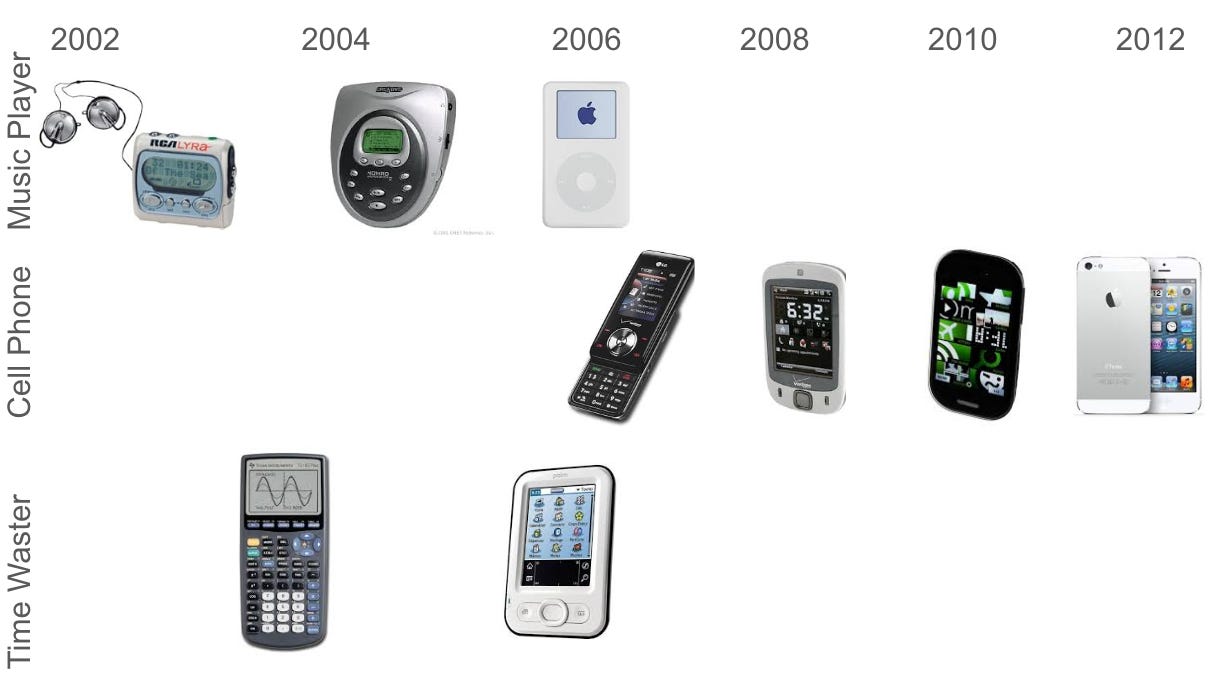
In high school (2004), my primary programming and time-wasting device became my TI-83 Plus graphing calculator. I made (and played) games, and built math programs to do my homework for me (that sounds familiar). I graduated in 2007, which meant that the iPhone didn’t exist while I was in high school, but I did have my share of MP3 players and even a Palm Pilot with a color screen! The girls that I chatted with on AIM back in middle school thought it was impressive. I got my first cell phone, an LG Chocolate, as I went to college to study computer science.
As I think back on it now, I can see at the root of it my love of learning and my love of solving problems. Books and digital tech are still ways that I learn about the world and whatever hobby I’m into. I enjoy mysteries because the detectives are master problem solvers. I still use code and other digital tech to help solve problems.
I can also see that my love of digital technology drove me to pursue and adopt the newest devices and capabilities reflexively. MP3 players were clearly superior to CDs, which were obviously more advanced than those ancient vinyl records (those will never come back). iPods were better than my first 128 megabyte MP3 player—they had gigabytes of storage! Why not download MP3s from LimeWire? I need to fill up my iPod. Of course I want a Palm Pilot: it’s even better at playing games in class than my TI-83!
I was limited in my ability to fulfill my desires, but not because of limits I placed on myself. I was limited by my parents, who wisely put rules on our screen time and didn’t buy me devices. I didn’t have enough money to buy the latest and greatest tech, so I had to settle for used, older models off of eBay. We had dial-up internet at my parents’ house until I went to college, so there was only so much pirated music I could download.
When the iPhone became popular while I was in college (2008), I desired one. Yet limits still held me back. The phone itself and the data plan were too expensive for me as a college student, so I cobbled together a series of “phones of middling intelligence,”not as good as the real thing, but enough to satisfy my desire. I finally got myfirst iPhone in 2012, by which time I had a full-time job and was married. These also introduced their own kind of limits, now that money no longer served that purpose.
A Need for Limits
The pandemic took my philosophy of technology and accelerated it to its logical conclusion. Digital technologies replaced most of what previously happened in the physical world. At first it seemed this transition was going well, at least in my case. But by 2021, it was increasingly clear to me that this new digital existence was making me miserable. I felt burnt out at work and exhausted at home (different digital spaces but the same physical space). I had applied my usual method—solve problems with newer and better technology—but it wasn’t working. We upgraded from Skype for Business to Microsoft Teams, which was supposed to improve our digital collaboration. But I just ended up on Microsoft Teams calls for five or more hours a day, often starting at 7:30 a.m. All communication happened in video calls, instant messages, or email. Teams was better than Skype for Business from a technology perspective, but it wasn’t making my work life better. When I wasn’t working, I was listening to a podcast or scrolling Twitter (or both). I was using better technology than ever, but none of it seemed to be making me happy. I could see that I had a problem, but I didn’t know how to solve it.
I looked for answers in books. Cal Newport released “A World Without Email” in March of 2021, and after a year of digital communication that world sounded appealing. That book led me to “Digital Minimalism”. From “A World Without Email”, I learned that part of my misery was due to my living in a “hyperactive hive mind”, his term for the web of messages, emails, and video meetings that defined my daily work life. In “Digital Minimalism”, I saw the same pattern in my personal life. I was constantly connected to the digital world via a podcast in my earbud or the Twitter feed on my screen. I was never fully present or focused on one thing or person. I was treading water in a sea of digital communication that threatened to pull me under. I needed a life preserver. I needed limits.
So I followed Cal’s advice. It wasn’t easy. It involved a constant setting and resetting of limits. At work I began to limit the time I would check email and instant messages during my workday, but it would slowly creep back to dominating my day. I would decline meetings or try to turn more meetings into emails, but my calendar would fill up again. Yet over months and years, setting and resetting, I saw progress.
I still struggle with limiting my podcasts. You may be thinking: “Really? Podcasts?” Yes, podcasts. I love to learn, and podcasts can be a good way to do that. But it’s very easy for me to get to a point where I’m just listening to podcasts in my earbud at high speed almost all of the time. They prevent me from being present. Present at work. Present with my wife and kids. Present with myself. I realized during the pandemic that I was using podcasts as a way to avoid thinking about the uncertainty and difficulty in my life. I was using them like a drug to keep my mind from these negative thoughts.
I still do.
I have to keep a regular practice of removing the podcasts from my subscriptions that serve as drug-like distractions and reset my attitude toward the ones that remain. For me, podcasts can be used intentionally to learn. They cannot be used to disengage my brain or to avoid being present with myself or others.
Individual limits on instant messages and podcasts are important, but another thing I’ve learned is that limits also need to exist at the family, workplace, and community levels. You will not (I have not) set limits at the individual level and keep them. Individual limits need to be set, but in the context of a relationship, family, team, or community that limits themselves similarly. You can’t do it alone.
You will also need to answer the most important question: Why? Though I came to Cal Newport’s work to learn how to stop spending so much time on email and be more productive at work, that’s not what his larger project is about. It’s to cultivate what Cal calls a “deep life”:
To me, the deep life is about focusing with energetic intention on things that really matter — in work, at home, and in your soul — and not wasting too much attention on things that don’t.
…
The tricky part in cultivating a deep life, of course, is figuring out what things matter. This will differ between different people. I strive to divide my focused attention among four categories:
community (family, friends, etc.),
craft (work and quality leisure),
constitution (health), and
contemplation (matters of the soul).3
If you are living a deeper life, one full of things that matter to you, keeping limits becomes much more sustainable.
My work day is no longer dominated by Slack, email, and Zoom meetings. I haven’t been on X/Twitter in years. I listen to podcasts at normal speed and only during activities where I can actually learn from what I’m hearing, like long drives or folding laundry. I am more focused and present in my job and at home. I spend more time and attention on activities like reading, writing, learning piano, hiking, and bird watching. I am developing deep relationships with my wife, children, friends, family, and coworkers. This is my “why”. Your “why” will be different, but I can assure you that unless you know why you are setting limits, you will not keep them.
A Techno-Selectionist
It’s been four months since I last published something on this Substack. I’d like to say that it’s because I’ve been deeply reading on new topics to write about, or it’s because I chose to use my writing time on a new hobby. But the reality is that I chose to spend 90 hours beating the video game “Hollow Knight: Silksong,” and I chose not only to beat it, but to collect 100% of the items and upgrades along the way. I still love digital technology. I love learning the geography and history of the land of Pharloom, in which the game is set. I love solving the puzzle of a difficult boss, or finding the way to my destination via an unmapped route. The cycle of learning and then using that knowledge to solve the problems gives me a sense of accomplishment and satisfaction.
Is this how I should have spent those 90 hours? As I write this, my regret is not in playing or beating the game, but in how I went about it. I should have limited myself to only using a portion of my free time playing it, leaving time for other activities. I should have continued to follow my parent’s limits: 1 hour of video games per day. I shouldn’t have pursued 100% completion, which added more time but not necessarily more enjoyment or satisfaction.
I write this to say that I don’t have it all figured out. I haven’t reached some state of perfection. I am still the kid who loves digital technologies because they provide opportunities to learn and solve problems. I don’t think that’s going to change, or even if I want it to. But there are other means to that end. Ways that don’t shortcut the learning process by doing the thinking for me. Paths that give me problems to solve for the benefit of those around me, not for a dopamine hit. What I have learned about myself is that I will not pursue those other avenues without putting limits on digital technologies. Limits that enable me to do the things I want to be doing. Limits that I share with my wife and family, that we keep together.
My philosophy of technology has changed to be more like what Cal Newport calls a “techno-selectionist”:
This is a perspective that accepts the idea that innovations can significantly improve our lives but also holds that we can build new things without having to accept every popular invention as inevitable. Techno-selectionists believe that we should continue to encourage and reward people who experiment with what comes next. But they also know that some experiments end up causing more bad than good.4
Instead of just blindly adopting new technologies, I am selective about which ones I will invest my time and money in. For the ones that I continue to use, I set limits. I know what this process looks like for me, I know what it looks like for Jerusalem Demsas, but I don’t know what this process looks like for you. I don’t know what your limits should be, what they will enable you to pursue, or who you will share them with. Each of us is unique, which means that each of us has to figure it out individually and with our own family and community. But I do know that if you aren’t practicing limits on digital technology, you are missing out on a better, deeper life. Go find what you’re missing.
Strangers to Friction is a reader-supported publication. To receive new posts and support my work, consider becoming a free or paid subscriber.
-
“Why Women Should be Techno-Optimists”, Jerusalem Demsas, The Argument ↩
-
“The Answer to Bad Tech is Better Tech”, Jerusalem Demsas, The Argument ↩
-
“The Deep Life: Some Notes”, Cal Newport, calnewport.com ↩
-
“It’s Time to Dismantle the Technolopoly”, Cal Newport, The New Yorker ↩