
Building The Hoard
Eustace had read only the wrong books. They had a lot to say about exports and imports and governments and drains, but they were weak on dragons. That is why he was so puzzled at the surface on which he was lying. … And of course Eustace found it to be what any of us could have told him in advance—treasure.
–The Voyage of the Dawn Treader, C.S. Lewis1
I am a hoarder. That applies both to physical objects (trading cards, books, electronics) and to knowledge in general. If you’re familiar with the Enneagram personality types I am a Five, which can be called “The Observer” or “The Investigator”. Fives prefer to observe, collect knowledge, use compartmentalization and privacy as defense mechanisms, and aren’t ruled by their feelings2. I have been building up my knowledge collection since I was a kid, but as one of my books3 on the Enneagram says: “the best and worst thing that ever happened to Fives is the advent of the internet”4. When I only had access to the books in the library and at home, I could indulge my knowledge cravings only so far. Once I had regular access to the (dial-up) internet, I feasted at the buffet of information.
I haven’t stopped. As an adult I found podcasts, a medium that seems to have been invented to appeal to everything an Enneagram Five would want. I can observe other people’s conversations without the annoying bit where I actually have to stand around awkwardly and participate every once in a while. There’s a podcast on pretty much every niche topic I would ever want to learn about. I can listen to them privately on my wireless earbuds; no one else has to know what strange fascination I have at the moment. Best of all: the number of podcasts continues to increase, so there’s always more to listen to. This can lead to long backlogs, but I can take care of that by listening at increased speeds.
My podcast app of choice is Overcast, and has been since 2015. Overcast is built and run by a single person, Marco Arment. When he announced the app in 2013 you can tell he loves podcasts for many of the same reasons that I do:
They’re listenable in many common situations where other media is not consumable ... such as driving, long road trips, short errands, walking the dog, walking around, walking to work. During mindless tasks like cleaning, yard work, washing dishes. I listen to podcasts all the time, it’s fantastic. They fight boredom, they fight loneliness, they just entertain you. They inform you. They make you think.
His goal when Overcast launched in 2014 was to make it easier to listen to podcasts, “to help people who already like podcasts listen to more of them”. The two key features that set the app apart at the time were Voice Boost, which helped make lower-quality recordings more listenable, and Smart Speed. Smart Speed helped increase the speed of listening by shortening pauses and silence in the podcast. As Marco wrote:
Playing at faster speeds has always helped people make time to hear more podcasts, but it usually came at the expense of sound quality and intelligibility. Smart Speed is like getting another speed increment for free: it saves time without sounding weird.

The app worked exactly as Marco designed it. With Voice Boost on, I could listen at 2x speed, even on podcasts with less than ideal audio quality. Smart Speed gave me that extra speed increment without it becoming too hard to understand. I listened to more podcasts by filling more of my spare time with them. I don’t have proof of it, but I suspect that Overcast is my most used app of all time (if you include listening time).
I don’t think it’s a coincidence that before Marco Arment built Overcast he created one of my other most used apps of all time, Instapaper. I didn’t realize that Marco created Instapaper until researching for this piece, but it was in some ways my least surprising discovery during my research. If the goal of Overcast is to “help people who already like podcasts listen to more of them” the goal of Instapaper is to “help people who already like reading web content to read more of it”. From his launch blog post in 2008:
You come across substantial news or blog articles that you want to read, but don’t have time at the moment.
You need something to read while sitting on a bus, waiting in a line, or bored in front of a computer.
Instapaper solves both of those problems.
Instapaper’s success can be credited with the “save for later” feature that is now embedded into most browsers and many websites.
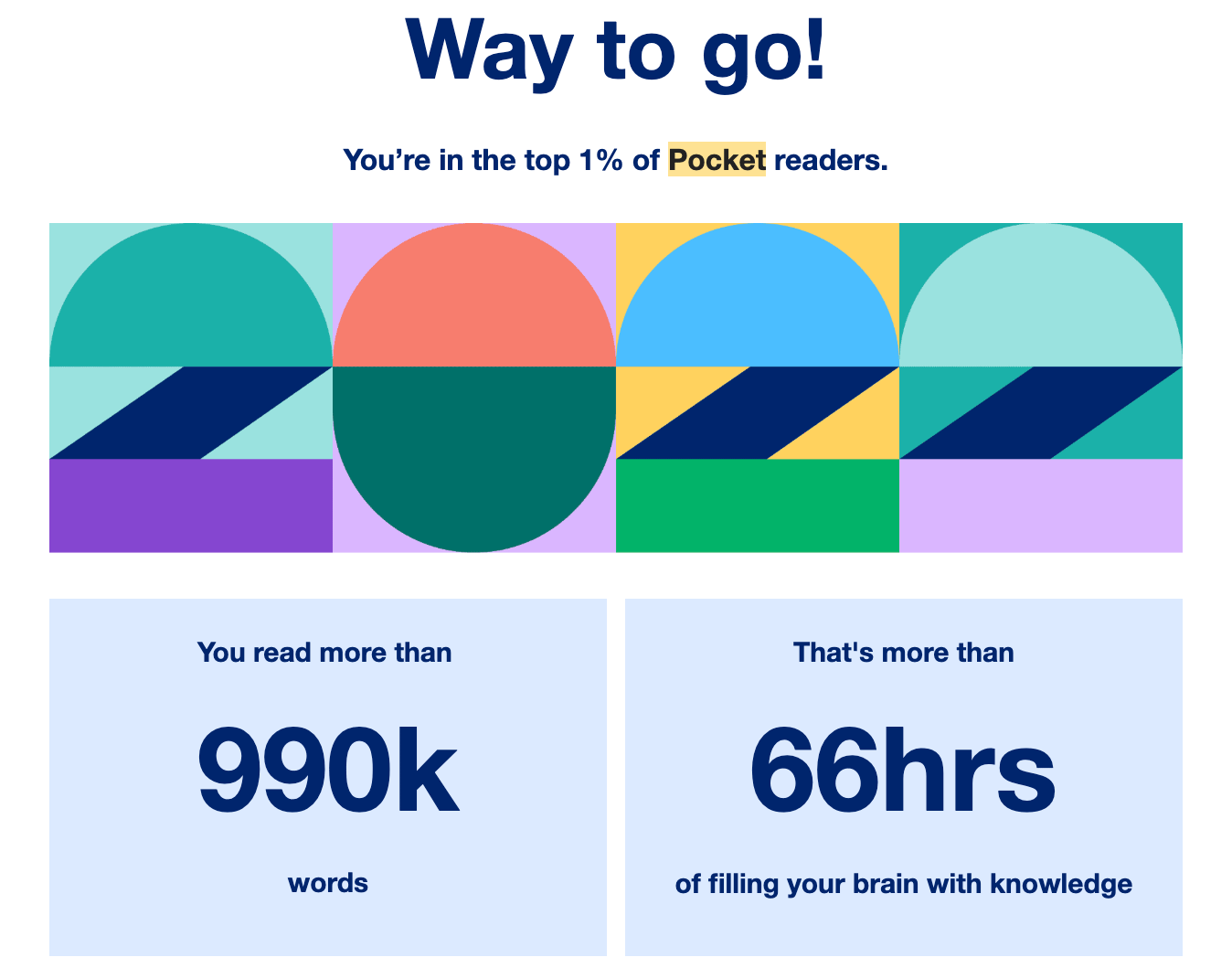
I used Pocket (RIP) instead of Instapaper for one reason: its text-to-speech functionality. Instapaper did have text-to-speech, but the free version only allowed you to listen to one article at a time. I wanted to listen to articles just like podcasts: as a playlist that could be delivered to my ears at increased speed. Pocket didn’t have Smart Speed, and the text-to-speech voices were unintelligible at 2x, but I settled for 1.5x and “read” more articles than I would have without the app. I would guess that it’s my second most used app of all time: I was consistently in the top 5% of all Pocket users, according to the emails they sent me. I stopped using it in 2023 when many of the sites I saved articles from started adding text-to-speech from the AI company ElevenLabs, which was much better for listening at high speeds.
Becoming a Dragon
He had turned into a dragon while he was asleep. Sleeping on a dragon’s hoard with greedy, dragonish thoughts in his heart, he had become a dragon himself.
–The Voyage of the Dawn Treader, C.S. Lewis5
For years now I have been building a digital product that I’ll call “Stream”. It combines multiple apps, connector software, and devices together. I’m its only user. The goal of Stream is as follows:
Create an endless stream of knowledge by collecting articles, podcasts, books, and videos.
Insert that knowledge into my brain via my ears.
Stream has been incredibly successful. It’s accomplished that goal and is my most used digital product of all time. But more recently I’ve started to see that it indulges some of my worst impulses.
Each Enneagram type has a corresponding vice, typically one of the seven deadly sins. For Enneagram Fives the sin is avarice or greed:
Avarice also expresses itself in the Five’s excessive desire for acquiring knowledge, information, ideas, conceptual models, expertise, interesting facts and understanding for how things work. Fives look to knowledge to provide them with what most people find through relationships, such as love, comfort and support.6
When I use Stream I am acquiring knowledge, but I am also hoarding my time. I have become a dragon, but instead of treasure I collect “empty” moments of time and trade them for knowledge. I can’t put my time into a pile to use later, so I convert it to information and save that instead. I sleep on a larger hoard of knowledge every night, built from pieces of my time.
But those “spare” moments of time aren’t really empty. If I have an earbud in around the house, I am taking the time where I could be listening to my kids play and spending it on my quest for knowledge. I fill every spare moment with information in my ear, leaving little mental energy for a conversation with my wife in the evening. My earbuds deliver knowledge but hold back opportunities for conversation at work or in the grocery store. Stream fills those moments with a flow of knowledge but floods out opportunities for connection with other people. I think I am finding “love, comfort, and support” in a podcast, but it actually keeps me from receiving those things from the people in my life.
This realization has led to further modifications to Stream. I stopped using text-to-speech on articles and now send them to my Kindle to read. As I have previously written, I periodically prune my list of podcasts to keep the stream from becoming a flood. I’ve started keeping a pocket notebook with me to capture thoughts or ideas as I listen, which will make it easier to decide which podcasts to cut in the future.
I have even started listening at normal speed. I tried going back to 1.5x speed as I was writing this, and it seemed incomprehensibly fast to me. I still use Overcast with Smart Speed and Voice Boost; Marco’s app remains great after 11 years.
I have thought about trying to stop listening to podcasts completely, but I’ve realized the benefits outweigh the downsides with the right limits in place. They help me learn, give me ideas to think about, help me see different perspectives, and can make me a better person. I talk to my family about podcasts we have in common, or share episodes with friends and coworkers. They inspire me to write and share my thoughts and feelings with you. But I have to always be on guard against my dragonish impulses.
We Are All Dragons Now
He wanted to get back among humans and talk and laugh and share things. He realized that he was a monster cut off from the whole human race. An appalling loneliness came over him.
–The Voyage of the Dawn Treader, C.S. Lewis7
I am worried that it’s not just Enneagram Fives like me who are becoming dragons. We are often antisocial by nature: podcast and video apps have just made that tendency worse. But the same technologies seem to be having a similar effect on other, more naturally social personality types. We are all trading spare moments of time for some kind of digital content: podcasts at 2x speed, audiobooks, TV shows, or short-form videos. Some of this is good, but it’s also contributing to what Derek Thompson calls our “Anti-Social Century”.
We’re trading time spent with other people for content that we consume by ourselves. Apps help us build a hoard of personalized treasure that is transforming us into dragons. It took becoming a dragon for Eustace to realize that he needed the company of his cousins and the crew, to see how he was isolating himself. It’s worked that way for me too. I don’t think Eustace and I are the only ones.
-
The Voyage of the Dawn Treader, C.S. Lewis, p. 87 ↩
-
The Road Back to You, Ian Morgan Cron and Suzanne Stabile, pp. 172–175 ↩
-
Yes, I have multiple books on the Enneagram ↩
-
The Road Back to You, Ian Morgan Cron and Suzanne Stabile, p. 173 ↩
-
The Voyage of the Dawn Treader, C.S. Lewis, p. 91 ↩
-
The Road Back to You, Ian Morgan Cron and Suzanne Stabile, p. 171 ↩
-
The Voyage of the Dawn Treader, C.S. Lewis, p. 92 ↩