
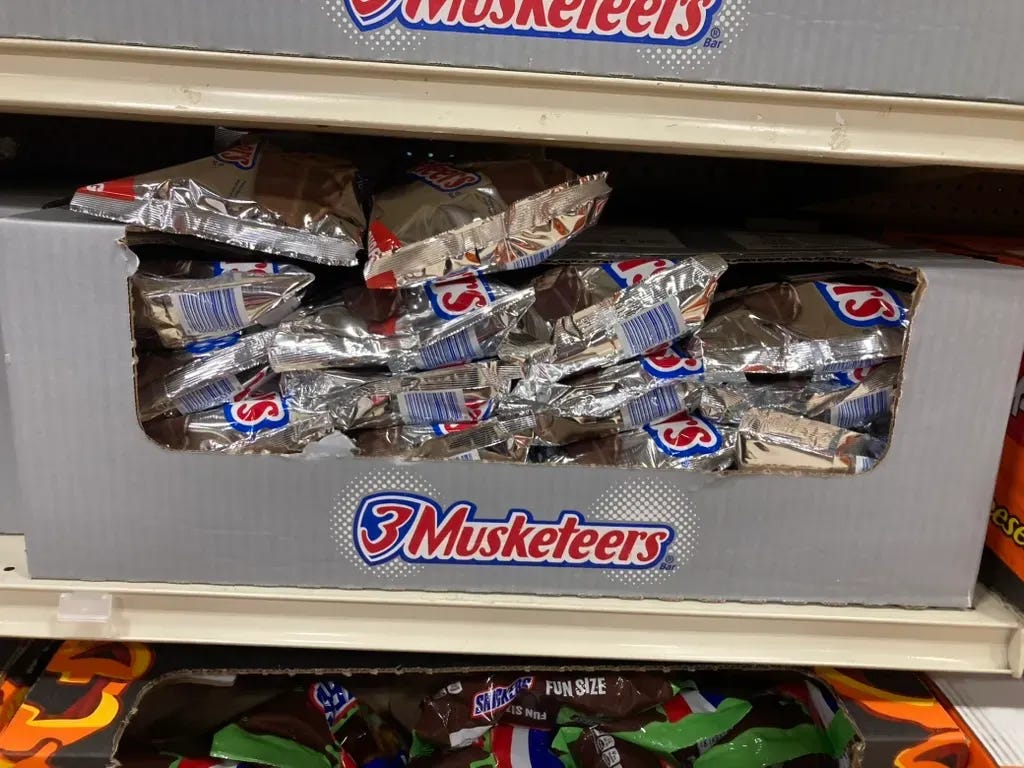
I know a little about how it feels to be dehumanized by a machine. My summer job while studying computer science in college was as a temporary employee at a chocolate factory. My eight-hour shift consisted of putting 24 bags of fun-sized candy bars into a box, taping the box shut, and putting it onto a conveyor. It was mind-numbingly boring. But the worst part was my coworker: the machine that did the same thing on the other production line. The only reason I was there was that it was cheaper to pay me during the increased Halloween production season than it was to install a second machine that wouldn’t be used the rest of the year. I was not a human being; I was a machine that was likely to be replaced at some point in the future.
This feeling of dehumanization has shifted from blue-collar factory jobs to white-collar “knowledge work” as generative AI has continued to improve in various fields. The announcement from OpenAI that an internal version of their upcoming Astra model generated “ten results, each of which resolves or makes substantial progress on a long-standing open problem” has brought the spotlight (or maybe the Eye of Sauron, as Cal Newport suggested) onto mathematicians. Kai Williams from Understanding AI wrote a great piece talking to mathematicians about it, but I appreciated his personal reflection even more:
For the first time, I viscerally felt what it’s like for AI to get really good at something I care about. Growing up, I always thought I’d be a mathematician — even these past few years have sometimes felt like a break from my inevitable math PhD. Yet at the same time, I was very glad that I’m a journalist now.
It’s hard when it hits you. For him it “felt like a punch in the gut,” and he experienced the grief of potentially giving up on his original plan of a math PhD. If you haven’t had this “visceral feeling” yet it may only be a matter of time.
Many software engineers felt similarly when the combination of Claude Code and Opus 4.5 in late 2025 made coding agents reliable enough that they could write almost all of the code. They saw AI coding apps the same way that I saw the machine that put candy bars in boxes. They are now working with machines that can write code faster and cheaper than they can. Adam Leventhal, Bryan Cantrill, and Simon Willison coined the term “Deep Blue” to describe what they were feeling: a “sense of psychological ennui leading into existential dread.” The term is a reference to the chess players who felt a similar “Deep Blue” feeling when Garry Kasparov lost to the computer called Deep Blue in 1997.
Many people (including me) thought software engineers would be replaced by machines in a few years. But it’s been nine months, and software engineers have adapted to working with the machine. One of my brothers is a mechanical engineer. He doesn’t actually build the things he designs. His job is to make sure that the things he designs will work well under various conditions; someone else does the building. Software engineering has always had that same goal, but engineers did both the design and the building. Now software engineers are having to adjust to no longer doing the building themselves. Software engineers aren’t being replaced (yet), but their job has changed dramatically in less than a year.
Many software engineers enjoy writing code. There’s a loss, a grieving, that many are experiencing. It’s still possible that they will be replaced despite their adaptations. I don’t know how things will go for mathematicians either. But most of the coverage of this math story is either hype or anti-hype. These math results are either a sign that the models will “keep plowing through every discipline the way they’re plowing through math”, or they are “amazing — but vastly oversold.” This pattern of hype and anti-hype after every AI announcement ignores the actual humans who will be left to figure out where the truth lies. People who will be affected in their day-to-day lives, who are trying to figure out what it means to be human when a machine can do parts of their work.
When I worked in the chocolate factory I wasn’t “punched in the gut” by the machine that did the same job as me, because I didn’t see putting chocolate in boxes as my real job. I was studying computer science to become a programmer: I tied my identity to that and not to packing chocolates. I eventually moved out of coding and focused my work on solving problems with technology more broadly. But getting out of coding was my choice; it wasn’t forced upon me because a machine could suddenly do it better or faster than I could.
For better or worse, we tie our identities to our jobs. “What do you do?” is almost always the first question that gets asked when you meet someone new. It’s how we define ourselves. When machines can suddenly do aspects of your job, your identity comes into question. It’s hard to go through. Let’s have some grace for the mathematicians and software engineers going through it now. You’ll need it if you have to go through it. I’ll leave you with this from Alberto Romero’s excellent piece on the topic:
First they came for chess, and I said nothing because I’m not a good chess player. Then they came for developers, and I said nothing because developers are such nerds. Then they came for mathematicians, and I said nothing because I hated math in school. And now that they’ve come for writers, I can only say that “I’m an AI assistant, what can I help you with today?”